
How to know if you're ready to work with an interior designer
Most people who would genuinely benefit from working with an interior designer leave it too late. They reach out once the plans are signed, once the framing is up, once the decisions that were easiest to get right are already locked in. By then, the work a designer can do has narrowed considerably.
There's also an opposite version of this problem, though it comes up less often. People who are at the very beginning of a vague idea, before enough clarity exists for the collaboration to be useful, are expecting a designer to make decisions that actually require input from the client first. The most valuable moment to bring in a designer is somewhere between those two ends — and knowing where you are on that spectrum is worth understanding before you reach out to anyone.
Scale matters less than timing
The assumption that interior design belongs only at the scale of a full renovation, or only once a certain budget threshold has been crossed, keeps many families from getting help that would genuinely serve them. In reality, a designer's value is tied far more closely to when they're brought in than to how large the project is.
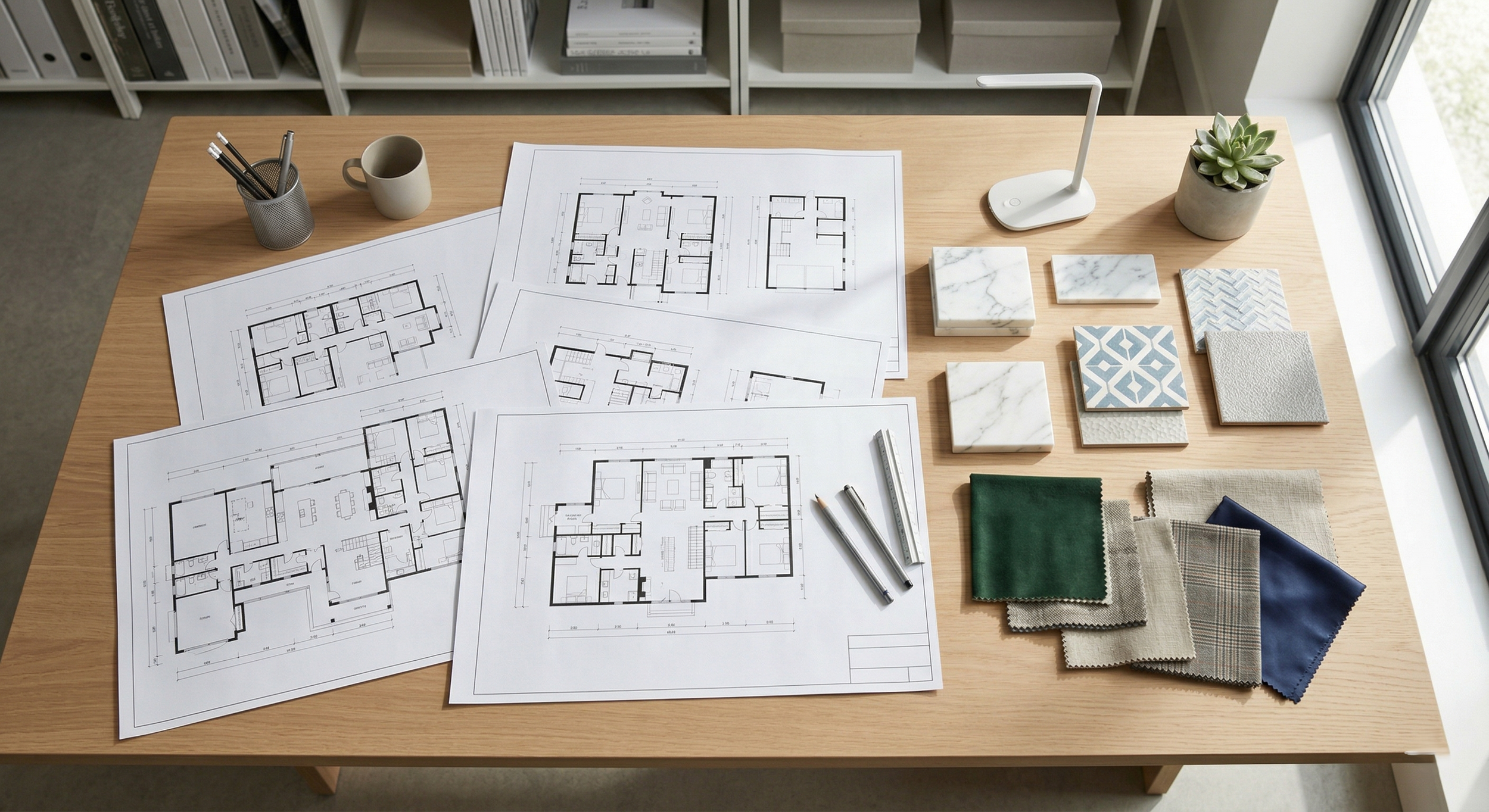
Before you sign a building contract, one focused conversation about your floor plan can prevent you from committing to spatial decisions you'll spend years working around. During a new build, a few sessions on key finishes and room logic can determine whether the finished home feels resolved or generic. In an existing home that's never quite worked, a clear brief and a few hours of concentrated input can unlock what years of incremental changes couldn't. The scale of the project changes. The value of getting the thinking right before acting doesn't.
What it feels like when the timing is right
You're building or renovating, and you want to get the spatial decisions right before they're permanent rather than discover the problems after handover. You've received plans from a builder, and something about them feels off, even though you can't articulate exactly what. You're approaching a new home with the intention of doing it properly from the start rather than accumulating furniture over the years and hoping it eventually coheres.
Or perhaps you've been living with a room that doesn't work, and you've tried several times to resolve it without quite getting there. You're facing a set of decisions, and you'd genuinely prefer to make fewer, better ones than to spend months in an exhausting shortlist. You want someone who understands how a home should feel, not just how it should look, and who can bring some clarity to a process that has started to feel overwhelming.
Any one of those is sufficient reason to reach out.
What an interior designer actually does
Sourcing cushions and choosing paint colours are part of the work at certain stages of certain projects. They're nowhere near the heart of it.
A considered designer reads a space in the way a good editor reads a manuscript — looking at the whole thing, understanding the intention behind it, and identifying what's working against that intention. The spatial dimensions. How light moves through the rooms at different hours. The relationship between rooms and whether those relationships serve the people living there. Where the logic of the plan breaks down and why.
What follows from that reading is a sequence of connected decisions. How a room is proportioned affects what furniture can live in it. Where furniture is positioned affects how light needs to behave. How light behaves affects materiality. These things are not independent choices — they're a chain, and getting the sequence right is what creates a space that feels resolved rather than assembled. The practical scope of the project varies enormously. The quality of thinking that makes it work well stays consistent across all of them.
The clients who get the most from the process
They don't always come with a fully formed vision. Often the opposite — they know how they want their home to feel long before they know what it should look like, and they're comfortable working from that. They're willing to trust a process that involves sitting with uncertainty for long enough to reach good decisions, rather than resolving everything quickly and then living with the consequences.
They also tend to have strong clarity about what they don't want. A client who knows they don't want a home that feels cold, or transient, or visually busy, or as it belongs to a version of them that no longer exists — that clarity is genuinely useful. It narrows the field in ways that make every decision easier. Good design rarely starts from a blank page. It starts from a well-understood brief, and knowing what to exclude is often the most useful part of that brief.
What tends to make it harder
Starting too late is the most common one. Once structural decisions are made, builder contracts are signed, and commitments to layouts are locked in, the leverage a designer has reduces significantly. The earlier the involvement, the more the thinking can actually shape the outcome rather than simply work within constraints that already exist.
Decision fatigue is another. Families who arrive having spent months working through an exhausting series of choices, who are hoping a designer will validate what they've already half-decided, often find the process frustrating rather than clarifying. A designer is most useful when there's still real room to think, not just to confirm. If you're approaching the end of your decision-making energy rather than the beginning, it's worth pausing before engaging anyone.
And sometimes there's simply a mismatch in what the collaboration is meant to achieve. If you're looking for someone to help you execute a look you've already decided on, there are services well-suited to exactly that. If you want a home that genuinely reflects how your family lives and what your home is meant to mean to you, that requires a different kind of conversation — one that begins with questions rather than a mood board.
Where to start
Not with a fully formed brief. Not with a resolved budget or a clear idea of what you want every room to look like. Not even with certainty that the timing is right.
A good first conversation starts with wherever you actually are — the plans on your desk, the room that's been bothering you, the new home you want to approach with more intention than you've managed before. From there, it becomes clear quickly whether working together makes sense and what form that would take. The first step is simply deciding to have the conversation before the decisions get made without it.
Book a consultation and let's figure out what your home needs.