
What most Sydney homes get wrong about family living
Sydney has produced some genuinely beautiful homes over the past decade. Walk through the right suburb, and the quality of construction, the attention to materiality, the architectural ambition, it is all there. And yet a surprising number of those homes, once you look past the photography, are not particularly well suited to the way families actually live.
That gap between beautiful and liveable is worth examining. Because for the families building or renovating right now, understanding it is the difference between ending up with a home you admire and one you genuinely love coming back to.
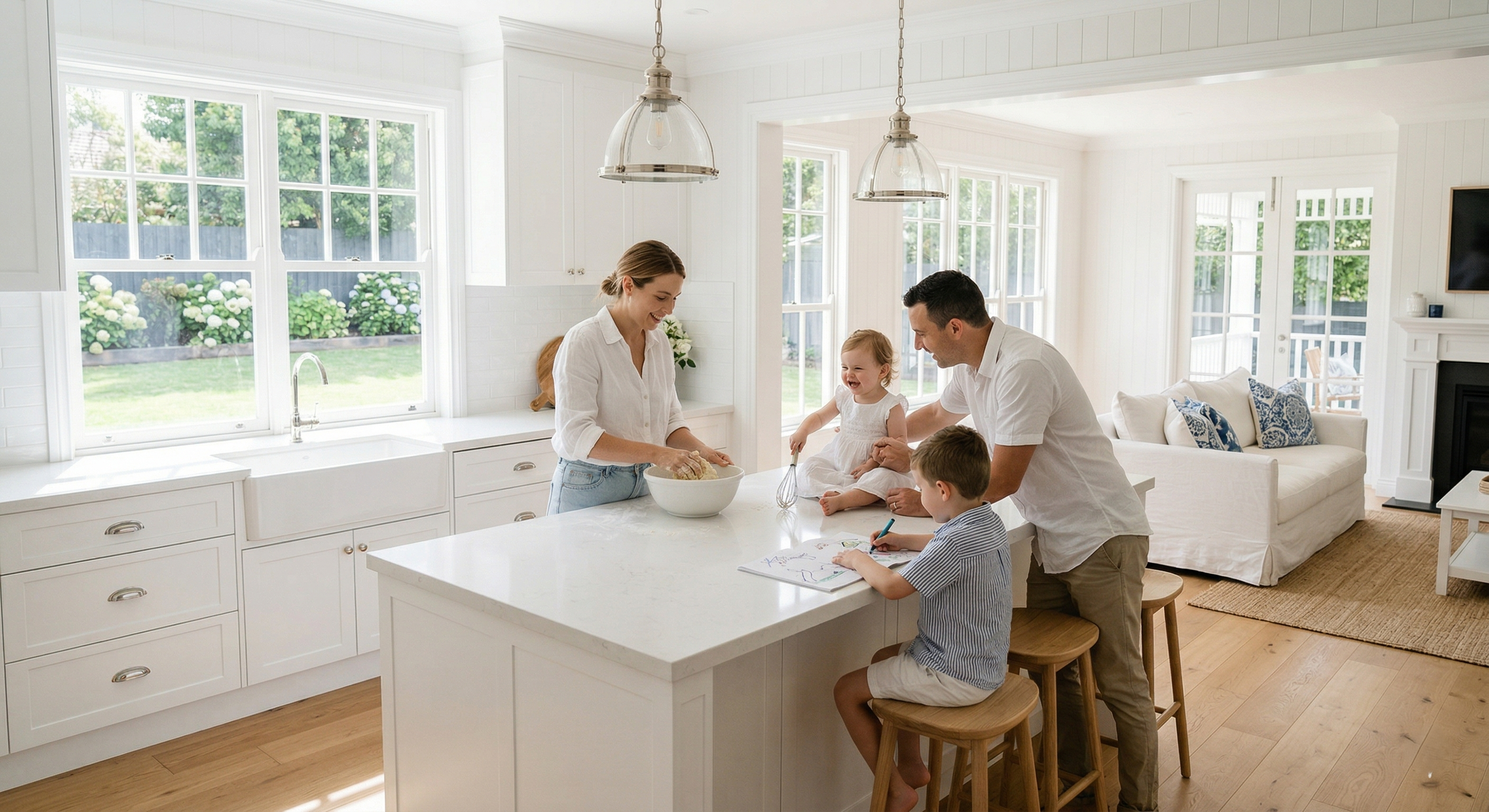
When homes are designed for the photograph
The interiors that perform best on social media share a recognisable aesthetic. Clean surfaces, restrained palettes, furniture arranged for visual balance. They are aspirational in a way that is easy to understand and easy to replicate. What they are less good at is holding an actual family life without starting to strain.
Considered design isn't about choosing clutter over calm. It is about designing spaces that can absorb real living, like a dining table with room to add two more chairs when people arrive unannounced, a kitchen bench long enough to actually cook at, a living room arranged for the kind of conversation that goes until midnight rather than the kind that works in a wide-angle shot. The homes that endure are the ones that look as considered on a school night as they do in styled photography. That's a harder brief to meet and a more honest one.
The entertaining blind spot
For many Sydney families, particularly those who grew up in households where hospitality was a matter of identity rather than occasion, the home needs to do more than shelter. It needs to host. Extended family, neighbours, colleagues, people who weren't invited but came anyway, the table that seats ten needs to work, the kitchen needs to stay connected to the dining room, and the indoor and outdoor spaces need to flow into each other in a way that makes a full house feel expansive rather than crowded.
Most new builds treat entertaining as an afterthought. The dining table gets pushed against a wall. The kitchen faces away from the activity. The outdoor terrace is accessible only through a single narrow door. These are small decisions in the planning stage. Over ten or twenty years of living, they compound into real friction in the rooms where you were supposed to feel most at ease.
The storage that's never quite right
Most families building new homes in Sydney end up with technically adequate storage that doesn't actually suit their lives. Pantries sized for two people. Wardrobes designed around capsule collections. Garages that become permanent overflow because the house itself ran out of room before it ran out of things to hold.
And then there is the question of display, which doesn't come up often enough in design conversations but matters enormously to how a home feels. Family photographs, objects collected across years of travel, pieces that carry meaning because of what they represent rather than what they cost. A home without considered places for these things doesn't just feel unfinished. It feels like it doesn't yet know who lives there. That's a harder feeling to shake than most people anticipate.
Designing for the full family, not just the nuclear one
A significant, often unacknowledged reality of Sydney's family homes is that many are genuinely multigenerational in use, even when they weren't designed that way. Parents who visit for weeks. Grandparents who've moved in. Adult children who've come back. The architecture of most new builds doesn't account for this.
Single-storey access treated as an optional extra. Guest rooms that communicate clearly that they're not meant for long stays. No thought given to how kitchen routines work when three generations are sharing one, or what acoustic separation actually means when teenagers and grandparents are sleeping in adjacent rooms. Getting multigenerational living right doesn't require a completely different brief. It requires someone to ask the right questions while there's still time to incorporate the answers.
How arrival gets underestimated
The moment of walking through the front door, for the first time and the five-hundredth time, is a design decision, even if it's rarely treated as one. What you see when you enter. How the space opens around you. Whether the home offers a sense of arrival, of welcome, of something worth coming back to, or whether it simply transitions you efficiently from outside to in.
For families who hold the home to a higher standard, who want it to feel like an expression of who they are, not just where they sleep, the entry is one of the most important moments in the whole house. It sets every expectation that follows. Most new builds leave it entirely to chance.
What it takes to close the gap
None of this requires an exceptional budget or a complete renovation. The homes that get it right are rarely the most expensive ones. They are the ones where someone asked better questions before decisions were made, where spatial logic and emotional intent were considered at the same time, where the brief went beyond finishes and room counts to include the actual texture of the life being designed for.
The families who end up in homes they love aren't luckier than anyone else. They had someone in their corner who understood that good design isn't about what a home looks like. It is about what it feels like to live there, year after year, in all the ordinary and extraordinary moments that make a house into something more.
If any of this resonates, a consultation is a good place to start. Book a time and let's talk through what your home needs.