
Why your builder's floor plan isn't working for your family
The plans land in your inbox, and you scroll through them carefully. The room sizes look reasonable. The kitchen is near the dining area. The bedrooms have windows. Everything, on the surface, seems fine. And yet something nags at you — a quiet sense that what you're looking at and what you want to come home to every day are not quite the same thing.
You're probably right. And the reason has nothing to do with your instincts being off. It has to do with what builder-standard floor plans are actually designed to achieve.
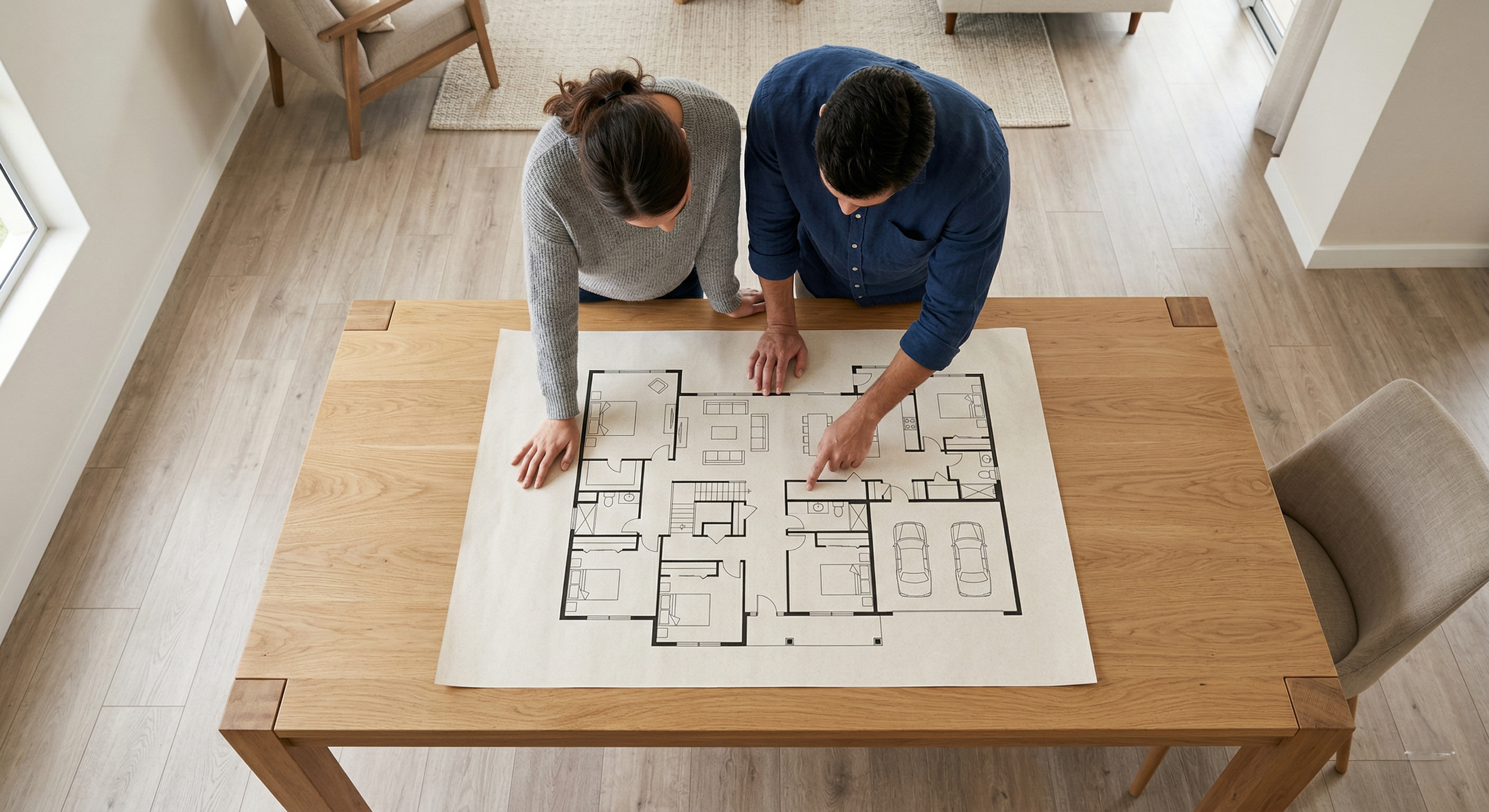
What builders are solving for
A builder's job is a complex one, and they do it well. Council approval, minimum setbacks, code compliance, construction efficiency, getting a home from plan to slab to handover on time and on budget is genuinely difficult work. What it isn't is a spatial design exercise centred on the life your family intends to live there.
Builder-standard plans are reused and refined across dozens of projects because they work in the technical sense. Rooms are compliant. Layouts have been approved before. The home will be built, passed, and handed over. But the thinking behind the layout usually stops well before the question of whether the space will actually feel right once your family is in it.
Liveability is about more than square metres
The homes that feel genuinely good to live in share something hard to measure on paper but easy to feel in person. A sense of flow. Rooms that know their purpose. Spaces that breathe. The path from the garage to the kitchen doesn't require you to walk through three different rooms when you're carrying groceries. The connection between an indoor dining space and an outdoor terrace makes Sunday lunches feel effortless. The entry that tells you you're home before you've even taken your shoes off.
These aren't decorative decisions. They're spatial ones, and they sit at the heart of whether a home works. Getting them right requires someone to think about how your household specifically moves, gathers, hosts, and rests — not just whether the room dimensions satisfy the minimum requirements.
The problems that are hardest to live with
Some layout issues are immediately obvious. An entry that opens straight into a living room with no moment of transition. A kitchen with no visual connection to where children are playing. A master bedroom shares a wall with a teenager's room, and no acoustic buffer between them.
Others are quieter but often more wearing over time. A dining area that seats eight in theory but practically requires everyone to shuffle sideways every time someone gets up. A living room oriented away from the natural light. No considered place for the objects, photographs and heirlooms that make a house feel like it belongs to someone. These things don't break a home. They make it slightly harder to love — every single day.
The real cost of a plan that doesn't get reviewed
Once concrete has been poured, the options narrow considerably. Moving a wall after framing has started costs tens of thousands of dollars and tests every relationship in the project. Requesting changes at the contract stage is far cheaper but still uncomfortable — and most families don't know what to ask for because they haven't had anyone walk them through what they're looking at.
A professional review of your plans before you sign anything costs a small fraction of one structural change. More valuably, it gives you the language and the clarity to go back to your builder with specific, grounded requests rather than a vague feeling that something isn't right.
What a thorough floorplan review actually examines
The spatial logic of the whole plan, not just individual rooms. How rooms relate to each other and whether those relationships serve the way you live. How morning light enters and where it falls in the afternoon. Where the flow gets interrupted and whether that matters for your household. How the home functions when it's full of people for a celebration and how it feels on a quiet Tuesday evening.
It also examines the life that will be lived there. Whether the home can flex for multigenerational living, now or in the future. How is arrival being handled at the front door? Where meaningful storage lives. Whether the home, as planned, has the capacity to feel like it belongs to you rather than to anyone who might have bought the same lot.
A builder can tell you the room is 4.2 metres wide. A designer can tell you whether that's the right room in the right position.
When to seek a second opinion
Before signing your building contract is the obvious moment, and the most valuable one. But a floorplan review is useful at other stages too: when you've already signed and want guidance on which optional variations are worth the investment, when you're partway through a renovation, and something isn't resolving, or when you're working alongside an architect or another designer and simply want a considered second perspective before decisions are locked in.
The goal isn't to create doubt where there was none. It's to give you genuine confidence, whether that means affirming what you already have or identifying the changes that will make it right.
If you've received plans and something doesn't feel right, book a consultation. We will look at them together.